The Digital Markets, Competition and Consumers (DMCC) Act is here, and it’s changing how you display prices on Shopify, TikTok Shop, and Amazon. If you’re still hiding mandatory fees until checkout to boost click-through rates, you are now non-compliant.
Let’s be honest: as sellers, we’ve all seen the psychology behind it. You list a product for £20, but by the time the customer hits 'Pay Now' on your Shopify store, there’s a £2.50 "service fee", a mandatory "processing charge", and the price has jumped to £25. It works for conversion—until now.
Since April 2025, the UK government has cracked down on drip pricing—the practice of "dripping" mandatory fees throughout the checkout process. For social commerce brands, D2C sellers, and drop shippers, this isn't just a suggestion. It is now enforceable law under the DMCC Act, and the Competition and Markets Authority (CMA) has teeth.
Here is what you need to know to keep your brand safe, your checkout legal, and your conversion rates healthy in 2026.
What is Drip Pricing and why is it banned?
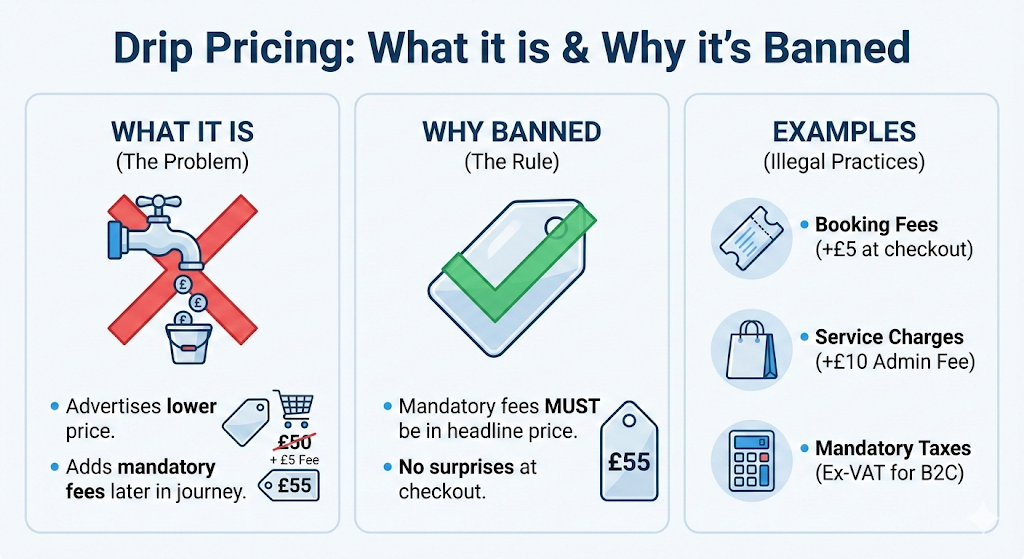
In simple terms, drip pricing is when a business advertises a product at a lower price but adds mandatory fees later in the buying journey.
The Rule: If a fee is mandatory (i.e., the customer cannot buy the product without paying it), it must be included in the headline price displayed on the collection page or ad.
Examples of Illegal Drip Pricing:
Booking Fees: Advertising a ticket for £50 but adding a mandatory £5 booking fee at checkout. The price is £55. You must show £55.
Service Charges: A Shopify store listing an item for £100 but adding a fixed "Admin Fee" of £10 in the cart.
Mandatory "Taxes": Listing ex-VAT prices to consumers (B2C) and adding VAT at the end (unless strictly B2B).
What is still allowed?
Optional Upgrades: Gift wrapping, express delivery, or insurance. Since the customer can choose not to pay these, they don't need to be in the headline price.
Variable Delivery Costs: Postage fees that change based on location (though these must be flagged clearly and early).
Sam’s Note: Don't think you can hide behind "industry standard." Since the ban came into force in April 2025, the CMA has been ramping up enforcement on online retail. If your TikTok Shop feed says £15, the customer better be able to check out for £15 (plus standard shipping).
Shopify Compliance 2026: Updating Your Storefront
For many of you running on Shopify, this requires a look at your theme settings and any third-party apps you use for dynamic pricing.
The "Service Fee" App Trap
Many dropshippers use apps to tack on small handling fees to pad margins. If you are using Shopify Scripts (or the newer Shopify Functions) to automatically inject a mandatory line item at checkout that wasn't visible on the Product Page (PDP), you are breaking the law.
Action Point: Review your Shopify Functions migration plans. If you are moving from Scripts to Functions, ensure your developer isn't just replicating old, non-compliant logic. Use the migration to clean up your pricing structure. If you need help untangling your tech stack from your financials, our Shopify Accounting Services can help ensure your backend data matches your frontend compliance.
Variable Fees
If a fee is variable and can’t be calculated in advance (like a complex shipping surcharge), the law states you must clearly explain how it is calculated immediately. However, for most D2C brands, "handling fees" are fixed. Just bake them into the product price.
What this means for your margins (and your accountant)
This isn't just a compliance issue; it’s a financial one.
When you bake a £5 service fee into your £50 product price (making it £55), your turnover figures look different. Your Average Order Value (AOV) metrics shift.
VAT Implications (Shopify Tax UK)
If you were previously separating out "service fees" to treat them differently for VAT (which is already a complex area often done incorrectly), combining them into a single product price simplifies things but might alter your liability if you aren't careful.
The Reality: Most "service fees" were standard-rated for VAT anyway. Bundling them usually changes nothing for tax, but it changes everything for perception.
The Fix: Update your Xero or QuickBooks integration. Ensure your revenue mapping reflects product sales correctly now that line items are merged.
How to fix your pricing strategy today
You don't need to lose revenue. You just need to change how you present it.
1. Audit your checkout flow Walk through your own store as a customer. Is the price on the collection page the same as the subtotal in the checkout (excluding shipping)? If no, why?
2. Reprice your inventory If you charged a £2 mandatory handling fee, increase all product prices by £2.
But Sam, won't I look more expensive?
Yes, but so will your competitors. The law applies to everyone. Plus, high cart abandonment often comes from "shock" fees at checkout. Honest pricing often improves conversion rates because trust is higher.
3. Update your Schema Ensure your Google Merchant Centre feeds match your new inclusive prices. If Google Shopping shows £20 and your site shows £25, you’ll get disapproved ads or angry clicks that bounce.
Quick fire Q&A: Compliance for Sellers
Q: Does this apply to shipping costs?
A: Standard delivery costs do not need to be in the headline price if they are standard. However, you cannot advertise "Free Delivery" and then add a "mandatory shipping surcharge" for everyone.
Q: I sell on TikTok Shop. Do I need to change anything?
A: TikTok Shop is aggressive on compliance. Their algorithm often suppresses listings with high negative feedback regarding pricing. Being transparent prevents returns and complaints, keeping your shop score healthy.
Q: Is this part of Making Tax Digital (MTD)?
A: No. Drip pricing is consumer law (DMCC Act). MTD is tax administration. However, both require you to have clean, accurate data in your backend. (And yes, MTD for Income Tax is coming in April 2026 for many of you—but that’s a blog for another day).
Final Thoughts from Sam
The era of "growth hacking" your way to sales via hidden fees is over. The UK market is maturing. Customers are tired of being tricked, and the government has caught up.
Don't look at this as a headache. Look at it as a chance to build a brand that people actually trust. Clean pricing, clear margins, and no nasty surprises at checkout.
Would you like me to audit your current checkout flow to check for hidden liability before the new financial year kicks in?
This guide is not financial advice. All content is for educational purposes only. Please consult a qualified accountant or financial advisor to discuss how these strategies apply to your specific business circumstances before making any financial decisions.
Sam Hoye
Founder
Sam Hoye is a specialist ecommerce accountant and founder of Social Commerce Accountants. With years of experience advising TikTok Shop sellers, Amazon FBA brands, and D2C influencers, Sam builds modern, scalable financial systems for the next generation of retail.
Forget generic templates. Answer a few quick questions and our AI will generate a custom 12-month Excel profit engine tailored to your specific marketplace and supply chain.
Custom-Built Architecture
Logic that adapts to your setup—whether you sell on Shopify, Amazon FBA, or TikTok Shop.
Tax & Logistics Ready
We bake in the hard stuff: UK VAT, EU OSS, and complex landed cost calculations automatically.
True Profit Clarity
A professional-grade dashboard delivered instantly. See your real margins and forecast with confidence.


.svg)